


In the corporate world, efficiency is the watchword. But what Valve Corporation is doing defies the logic of modern capitalism. New data from Alinea Analytics and Menlo Ventures reveal that the owner of Steam is, statistically, the most efficient company in modern history (outside the volatile crypto sector).
With estimated revenue of $16.2 billion and a lean team of about 350 people, Valve generates a staggering $50 million per employee. To put this in perspective, Gabe Newell’s company isn’t just beating the competition; it is playing a completely different sport.
David vs. Goliath (The Numbers Don’t Lie)

The disparity is shocking when comparing Valve to traditional “Big Tech” companies, which possess hundreds of thousands of employees and complex hierarchies:
- Valve: ~$50 million per employee.
- Microsoft: ~$18 million per employee.
- Apple: ~$2.4 million per employee.
- Meta (Facebook): ~$1.9 million per employee.
While Apple needs armies of engineers, designers, and retail salespeople to move its products, Valve operates a digital “money printing machine” (Steam) with a team that could fit on a single commercial airliner.
The Secret: Flat Structure and Million-Dollar Salaries
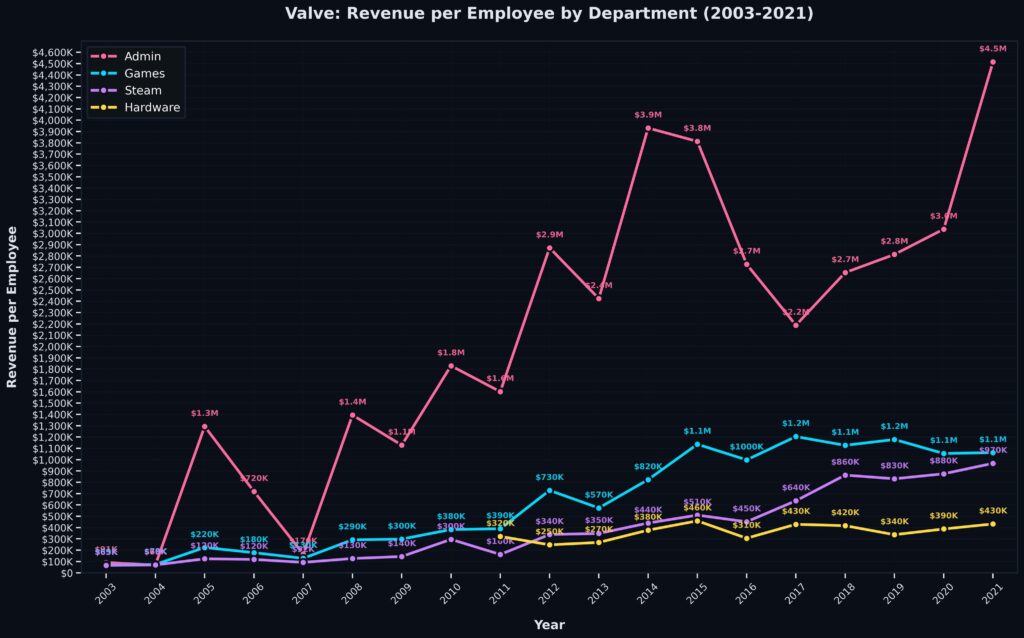
How is this possible? Valve is famous for its “flat” structure (no bosses or middle managers). They hire only the top tier of software and hardware development talent.
The company’s employee handbook, leaked in 2012, already stated: “Our profitability per employee is higher than Google and Amazon.” Newell’s philosophy is simple: keep the team small, talent density extremely high, and share the profits. Data indicates that the average salary at Valve hovers around $1.3 million per year. By avoiding corporate bureaucracy and focusing on the automation of its dominant platform, Valve has proven that in the digital realm, size doesn’t matter.
Source: Alinea Analytics / Menlo Ventures / The Verge.

 EN
EN  PT
PT  ES
ES