

In the era of information overload, simple linear note-taking is no longer sufficient. Obsidian emerges not just as a note-taking app, but as a complete infrastructure for what we call “Personal Knowledge Management” (PKM). Unlike traditional alternatives like Evernote or Notion, which act as static archives, Obsidian operates like a digital neural network, connecting ideas organically.
Here are the 5 pillars that make Obsidian an indispensable tool for modern thinkers:
1. Bidirectional Connections: The End of Folders
Obsidian’s greatest innovation is treating your notes like interconnected web pages. By using double brackets [[Link]], you create an instant connection between two concepts. This allows you to navigate your knowledge in a non-linear way, mimicking the associative functioning of the human brain. You don’t search for which folder you stored an idea in; you follow the train of thought that leads to it.
2. Total Ownership: Local Files and Markdown
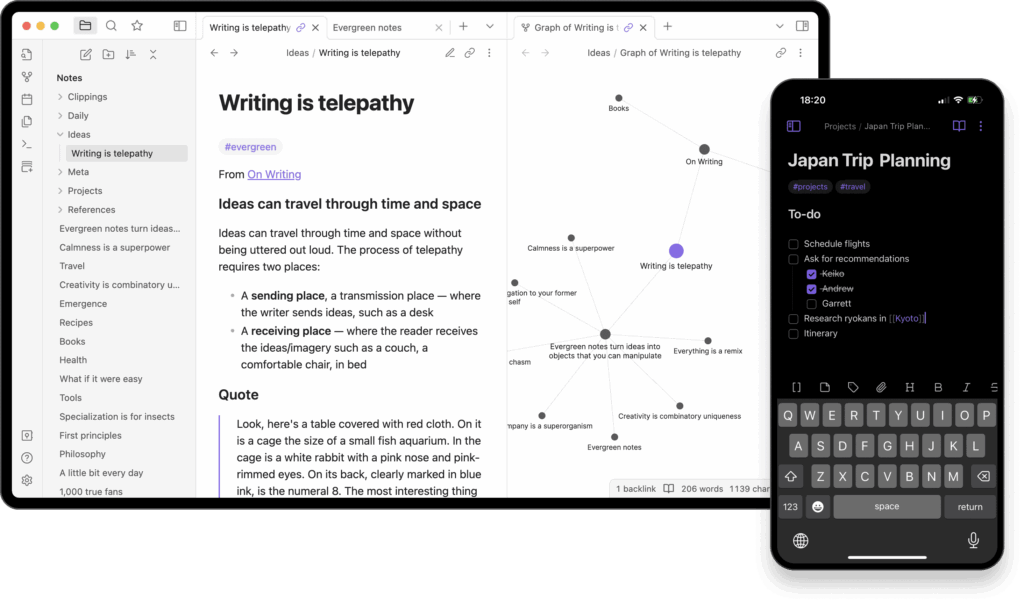
While most apps lock your data on proprietary cloud servers, Obsidian adopts a radical approach to data sovereignty. Everything is saved locally on your device in .md (Markdown) files. This guarantees that 20 or 50 years from now, you will still be able to read your notes in any plain text editor, regardless of Obsidian’s existence as a company. It is true “future-proofing” for your knowledge.
3. The Graph Visualization

Seeing your ideas visually connect is transformative. Obsidian offers a “Graph View,” where each note is a dot and each link is a line. Over time, you see constellations of knowledge forming, allowing you to identify patterns, gaps, and new theses that would be invisible in a flat list of documents.
4. The Power of Community Plugins

The base software is minimalist, but the extensibility is infinite. The Obsidian community has developed thousands of plugins that transform the tool into whatever you need: from a Kanban-style task manager and integrated calendars to spaced repetition tools (flashcards) for students. You mold the software to your workflow, not the other way around.
5. Focus on Writing and Deep Work
Being “offline-first,” Obsidian eliminates web latency and distractions. The interface is clean and content-focused. For writers, academics, and developers, this creates an environment conducive to “Deep Work,” where the friction between having an idea and recording it is reduced to zero.

 EN
EN  PT
PT  ES
ES