

In recent years, PC game rendering has undergone a paradigm shift. The era of “brute force”—where performance depended solely on how powerful the graphics chip was—is over. Today, we live in the era of Artificial Intelligence. With the arrival of the GeForce RTX 50 GPUs and the revolutionary DLSS 4, Nvidia promises to bury the concept of native resolution for good.
But what exactly do these acronyms mean? Why does your game run better (and sometimes look better) with them enabled? This is the definitive guide to upscaling technologies.
From Blur to Sharpness: The Evolution of Upscaling
The concept of upscaling is old: taking a small image and stretching it to fit a large screen. In the past, this resulted in blurry images. The game changed when Nvidia introduced DLSS (Deep Learning Super Sampling).
Unlike old methods, DLSS uses dedicated AI cores on the graphics card (Tensor Cores) to “reconstruct” the image. It analyzes previous frames, motion vectors, and game engine data to create a 4K image starting from a much lower resolution (like 1080p), often with more detail than the original image.
The Nvidia Timeline: From DLSS 1 to 4
- DLSS 1.0: An early attempt that failed. The image was blurry and inconsistent.
- DLSS 2.0 (The Turning Point): Introduced temporal reconstruction. Became the industry standard, delivering massive performance with impeccable image quality.
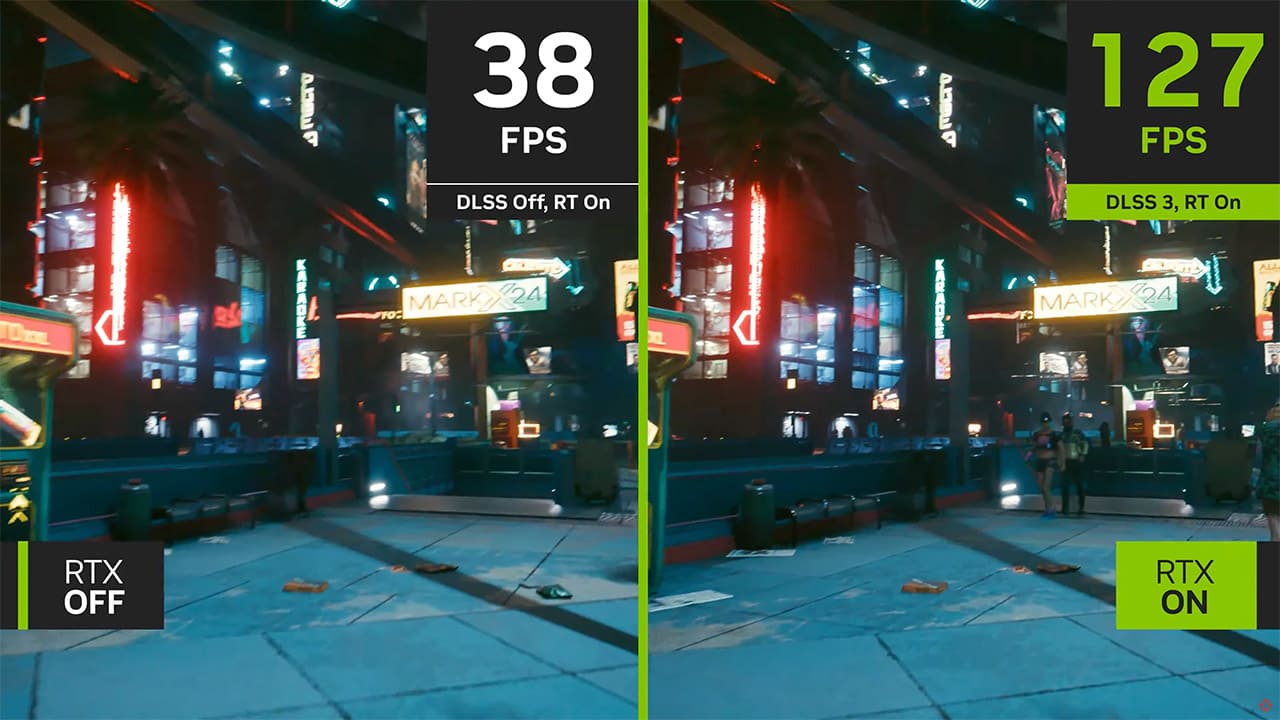
- DLSS 3.0 (Frame Generation): The magic of creating frames “out of thin air.” AI inserts an entirely new frame between two rendered frames, doubling FPS.
- DLSS 3.5 (Ray Reconstruction): Focused on light quality, replacing manual denoisers with AI to clean up Ray Tracing noise.
The DLSS 4 Revolution and Blackwell Architecture
The big news, brought by the RTX 50 Series cards, is DLSS 4. This version abandons old models and adopts an architecture based on Transformers (the same technology behind ChatGPT).
The highlight is Multi Frame Generation. While DLSS 3 generated one extra frame, DLSS 4 can generate up to three intermediate frames for every traditionally rendered frame. Thanks to the new Blackwell hardware, this happens without the input lag skeptics feared. The result? A performance leap of up to 8x compared to native rendering, with 30% less video memory (VRAM) usage.
The Alternatives: AMD FSR and Intel XeSS
DLSS has one flaw: it is exclusive to Nvidia. That’s where competitors come in:
- AMD FSR (FidelityFX Super Resolution): A software solution that works on almost any graphics card (including consoles like PS5 and Xbox). Although FSR 3 also features frame generation, it traditionally offers slightly lower image quality than DLSS in fast motion, as it doesn’t use dedicated hardware AI.
- Intel XeSS: A hybrid middle ground. It works best on Intel Arc cards (using AI hardware) but also runs on other cards in a simplified manner.
The Verdict: No Turning Back
Ray Tracing and Path Tracing have made modern graphics too heavy for current hardware to render natively. Upscaling is no longer an optional “trick”; it is the foundation of modern graphics engineering. With DLSS 4, Nvidia isn’t just increasing FPS, but redefining how pixels are created.

 EN
EN  PT
PT  ES
ES